French Drains in East Texas: When You Need One, and When You Do Not
If your yard holds water for days after a storm, the problem is usually not rainfall. It is that East Texas clay has nowhere to put it. Here is what a French drain does, when it is the right fix, and when it is not.
Why yards flood here specifically
Most of Gregg, Harrison and Rusk County sits on heavy clay. Clay particles are fine and pack tightly, so water moves through them extremely slowly. Sandy soil drains in hours. Clay can hold standing water for days.
Add a flat or gently sloped lot, a house pad built up higher than the yard, and the sort of downpour East Texas gets several times a year, and water simply has nowhere to go. That is not a landscaping failure. It is soil chemistry.
What a French drain actually is
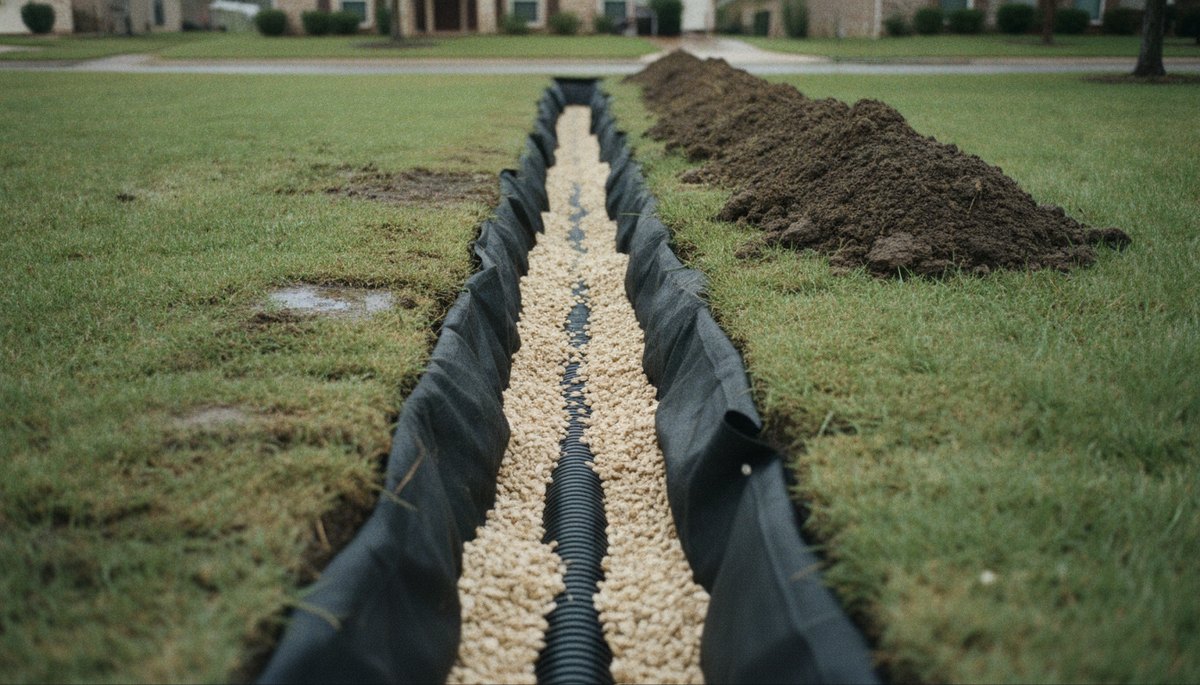
A trench, a perforated pipe, and gravel wrapped in filter fabric. Water in the surrounding soil enters the pipe through the perforations and runs downhill to somewhere it can safely leave.
Three things decide whether it works:
- Fall. It is gravity-driven. Without consistent slope along its length it becomes a buried trough that holds water instead of moving it.
- An outlet. The water has to go somewhere legitimate. A drain that ends nowhere just relocates the puddle.
- Filter fabric. Without it, clay silt migrates into the gravel and the system chokes. This is the single most common reason a drain works for two years and then stops.
Signs you need one
- Water stands in the same low spot for more than 24 hours after rain
- Persistent soggy ground you cannot mow without leaving ruts
- Moss, algae or bare mud where grass will not hold
- Water pooling against the foundation, or a damp crawl space
- Mulch repeatedly washing out of the same bed
- Gutters discharging straight onto ground that never dries
The foundation one is the one to act on quickly. In clay country, repeated wet-dry cycles against a slab move soil, and moving soil is considerably more expensive to deal with than drainage.
When a French drain is not the answer
This matters as much as knowing when it is, and it is where a lot of money gets wasted.
- Water sheeting off a roof. That is a gutter and downspout extension job. Far cheaper.
- A single shallow low spot. Sometimes regrading and filling is enough.
- Water coming from uphill next door. A swale or berm may be the better answer, and there may be a neighbour conversation to have first.
- Nowhere to discharge. If there is genuinely no lower point on the property, a dry well or a pop-up emitter is the honest alternative.
We will tell you when the cheaper fix is the right one. Selling a trench to someone who needed a downspout extension is a good way to never get the referral.
French drain vs the alternatives
| Option | Best for | Relative cost |
|---|---|---|
| French drain | Persistent saturated ground, water against the foundation | Higher |
| Surface / channel drain | Water running across driveways and patios | Moderate |
| Regrading | Shallow low spots, poor fall away from the house | Varies |
| Downspout extensions | Roof water dumping beside the slab | Low |
| Dry well | Nowhere lower to discharge to | Moderate |
What drives the price
- Length of the run
- Depth, which is dictated by where the water is and where it must go
- What the trench has to cross: turf, tree roots, driveway, utilities
- Whether an outlet exists or has to be created
- Restoration afterwards, including sod over the trench line
Anyone giving a firm price without walking the property after rain is guessing. The fall has to be measured.
Common questions
How long does a French drain last?
Properly built with filter fabric and real fall, decades. Built without fabric in clay soil, often only a few years before silt clogs the gravel.
Can I put one in myself?
The digging, yes. The part people get wrong is slope. A drain needs consistent fall along its whole length, and eyeballing it across a yard that already looks flat is how you end up with a buried trench full of standing water. If you do it yourself, borrow a laser level.
Will it fix water in my crawl space?
Often it helps considerably, because most crawl space water is groundwater arriving from outside. It is not a guarantee, and it should be diagnosed rather than assumed.
Can you put one under an existing lawn without wrecking it?
The trench line will be disturbed, there is no way around that. We cut it as narrow as the job allows and restore with sod so the line knits back in over a season.
How soon after rain should I call?
Ideally while the water is still standing. Seeing exactly where it sits and how it moves is worth more than any description, and it tells us where the fall actually is rather than where it appears to be.
Get it looked at properly
StClair Outdoors handles drainage, grading, sod and hardscapes across Longview, Kilgore, Hallsville, Diana and the surrounding area. Family-owned, based in Kilgore.
Call or text (903) 808-2993 for a free estimate, usually same or next day. If the fix is a downspout rather than a drain, we will say so.